
What If You Could Grow Your Container Business Without Filling the Yard With More Containers?
You Already Have the Customer. You May Be Missing the Product They Need.
If your company sells or rents Conex boxes, shipping containers, portable storage or jobsite equipment, you have already done the difficult part.
You have customers who need space.
Contractors need jobsite storage. Manufacturers need overflow capacity. Property managers need maintenance storage. Homeowners need temporary space. Landscapers, schools, equipment companies, municipalities and small businesses all come to container providers for variations of the same problem: we need secure space somewhere we do not currently have it.
Traditional shipping containers solve many of those problems very well. They do not solve all of them.
That gap is where modular storage can become a valuable additional revenue stream.
You Do Not Have to Replace Your Conex Business
This is not an argument for abandoning shipping containers.
A customer with an open equipment yard and a need for a large 20- or 40-foot steel box may be an ideal Conex customer. Selling them anything else simply for the sake of selling something newer would make little sense.
Another customer may have a narrow access point, limited placement space or no need for 20 feet of storage. Someone else may want a clean new unit rather than a used freight container. A residential customer might need 10 feet. A contractor may need a 13-foot tool store. A business may want a storage unit that can later be disassembled and relocated.
Those customers are not necessarily rejecting your traditional product. They have a different problem.
Adding Modular Building Solutions gives your sales team something to offer instead of saying, “A shipping container probably isn't going to work there.”
Inventory Economics Are Where This Gets Really Interesting
Traditional shipping containers consume their full physical footprint whether they are earning money or sitting in your yard.
That has consequences. Inventory requires acreage. Each unit represents capital. Moving a unit generally requires equipment suited to something that is already container-sized. Adding significantly more inventory can eventually mean adding more yard space, more handling capacity or both.
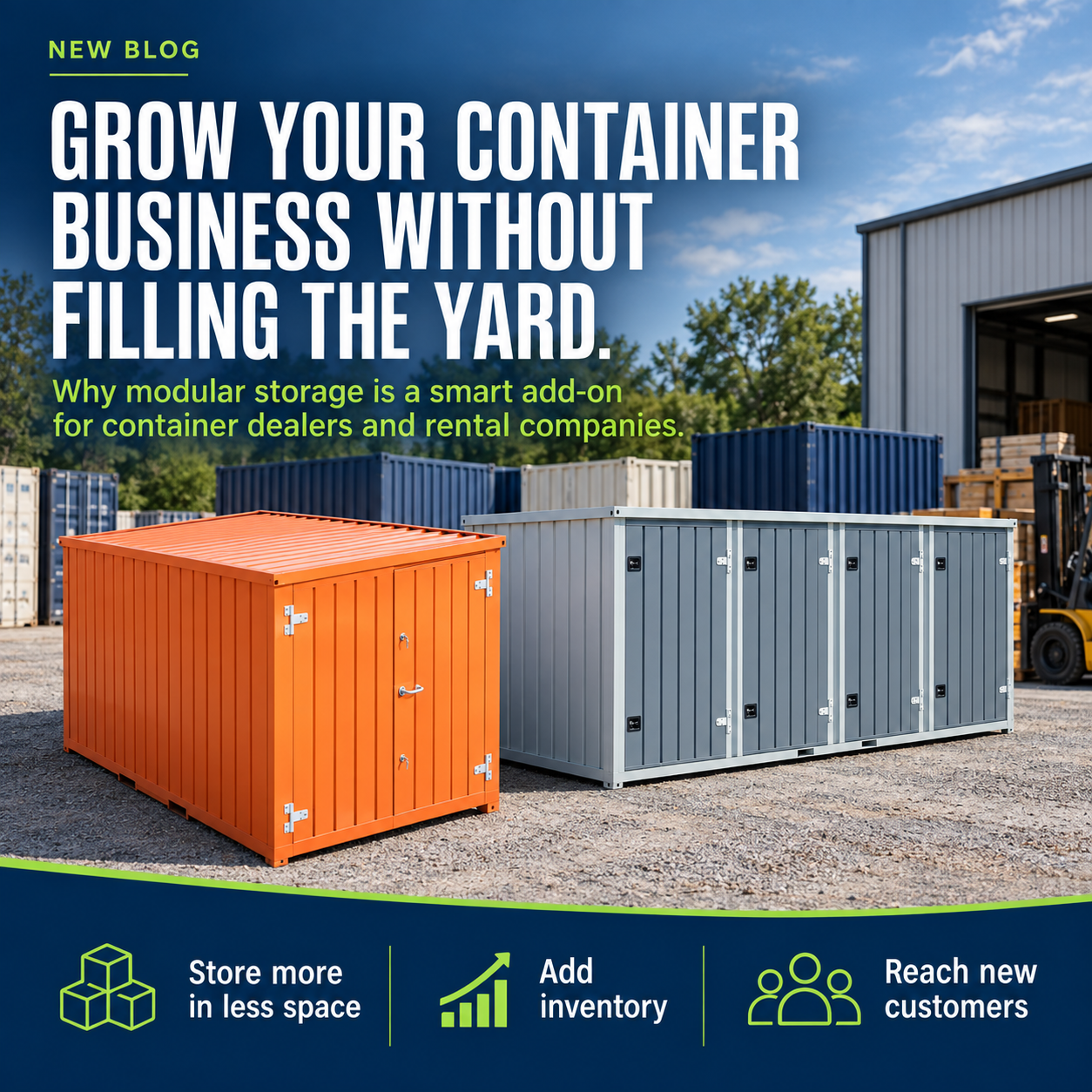
Modular units change that equation because they can be stored flat before assembly.
Instead of dedicating the finished footprint of every unit to inventory, a dealer can maintain multiple unassembled units in substantially less space. The exact freight and storage density depends on model and order configuration, but the basic advantage is straightforward: you are not paying to move and store empty air inside an assembled box.
For a dealer, that can make growth less dependent on expanding the physical yard at the same rate as the product offering.
Freight Can Become a Competitive Advantage Instead of a Necessary Evil
A traditional shipping container occupies the space of a traditional shipping container during transportation. There is no way around its dimensions.
The modular-storage industry is built around changing that relationship. Flat-packed units can be grouped for transport before final assembly, allowing multiple units to move within a freight footprint that would otherwise accommodate far fewer finished structures.
That matters in several ways. Dealers can replenish inventory more efficiently, expand into territories farther from the yard, consolidate larger orders and potentially reduce the transportation component attached to each individual unit.
It can also open opportunities with customers ordering multiple units. A general contractor equipping several sites, a regional property operator, a school system or an equipment company with multiple branches becomes a very different sale when the logistics are designed for multiple-unit deployment.
Add Sizes the Traditional Container Market Doesn't Naturally Serve
One of the simplest opportunities is size.
Modular Building Solutions offers storage options ranging from 3.5 feet through 19 feet. That creates meaningful selling space beneath the traditional 20-foot shipping-container category.
Think about how many customers need more storage but do not need 20 feet of it.
A small contractor may want a 10-foot secure tool room. A landscape company may need a 13-foot unit for equipment. A property manager may want a smaller maintenance store tucked beside an existing building. A homeowner may need seasonal storage but does not want a freight container dominating the property.
Those are customers a container dealer is already positioned to reach.
Sell More Than Storage
There is another reason the category fits an established container business so well: the customer base overlaps, but the uses extend beyond basic storage.
Modular Building Solutions also offers configurations for offices, kiosks and multi-compartment storage. That creates opportunities to serve jobsite offices, concessions, ticket booths, pop-up retail, event operations, athletic facilities and other customers who may never have considered buying a traditional shipping container.
The sales conversation changes from “What size container do you need?” to “What kind of space are you trying to create?”
That is a considerably larger market.
Your Existing Infrastructure Gives You a Head Start
A company entering portable storage for the first time needs to find buyers, understand delivery, develop commercial relationships and build local awareness.
An established Conex dealer already has most of those pieces.
Your customers trust you to solve space problems. Your sales team understands the category. Your yard, equipment, website, local search presence and commercial relationships already bring you in front of people actively trying to create storage.
A modular line simply gives you more ways to say yes.
That is why we see this as complementary inventory rather than competing inventory.
More Products. More Customers. Same Core Business.
The best new product categories are often the ones that do not require a company to reinvent itself.
For shipping-container dealers and rental companies, modular storage fits naturally beside what you already sell. It can address smaller footprints, difficult-access sites, customers who want new purpose-built storage and applications that traditional freight containers were never designed to serve.
You keep selling Conex boxes where Conex boxes work.
Now you have an answer for many of the places they don't.
Interested in adding Modular Building Solutions to your existing container or portable-storage business? Talk with us about dealer opportunities, inventory options and the product mix that fits your market.