
The Jobsite Storage Problem Contractors Have Been Solving the Same Way for Decades
The Conex Box Works. The Question Is Whether Renting One Again and Again Is the Best Long-Term Strategy.
There is a reason shipping containers became common on construction sites. They are large, durable and secure, and they provide a straightforward answer when tools, materials and equipment need protection.
For contractors moving continuously from one project to the next, however, there is another question worth asking:
Why keep renting jobsite storage when your company could own it?
A traditional rental may look inexpensive when viewed one month at a time.
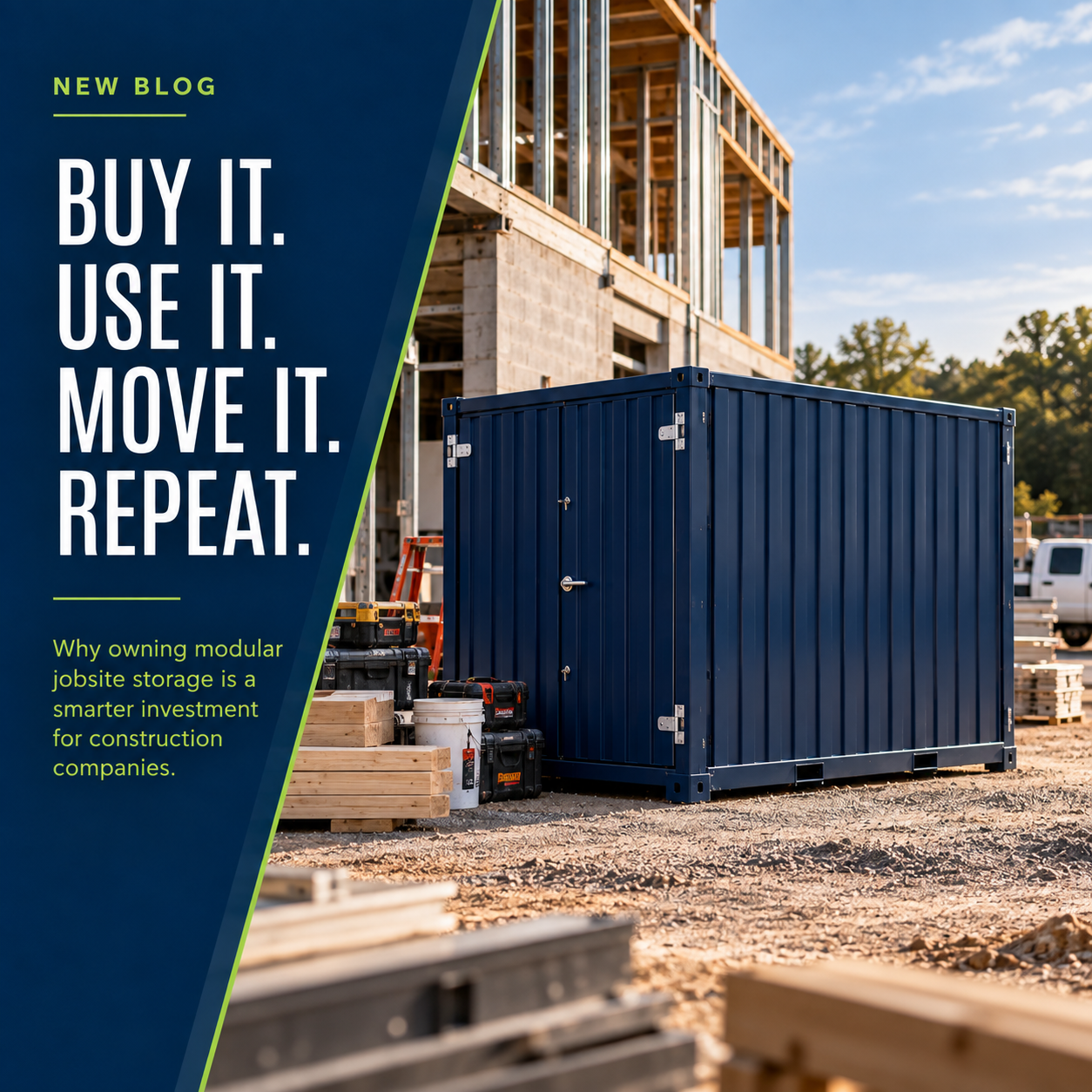
Add the monthly rental charges, delivery fees, pickup costs and repeated rentals across multiple projects, and jobsite storage becomes an ongoing operating expense.
Modular Building Solutions gives construction companies another option. Purchase the units as company assets, use them throughout the life of a project, then move them to the next job when the work wraps up.
Instead of starting the storage process over every time a new project breaks ground, the storage moves with your project pipeline.
Buy It Once. Put It to Work Again and Again.
This is where the ROI equation changes.
Imagine a contractor that regularly has three, four or six active projects. Traditionally, each new project may trigger another round of temporary-storage decisions: find available containers, arrange delivery, pay monthly rent and schedule pickup when the job ends.
Then the next project starts, and the process begins again.
With Modular Building Solutions, the company can begin building its own inventory of storage assets.
A unit purchased for Project A can move to Project B once Project A closes. Another can move from an early-stage project to a new mobilization once that project's storage needs decrease. Over time, a contractor can create a standardized fleet of company-owned storage that rotates through active jobs.
The unit isn't tied to the project.
It belongs to the construction company.
That means the longer and more frequently it is used, the more projects can share the original investment.
Think in Cost Per Project, Not Cost Per Month
Rental pricing naturally encourages contractors to think about storage in monthly increments.
Ownership creates a better metric:
What does this unit cost us per project over its useful life?
For illustration, suppose a contractor purchases a modular storage unit and ultimately deploys it across eight projects. The purchase price is no longer associated with one job. It has been spread across eight.
Use it across twelve projects and the effective storage cost per project falls again.
The exact ROI will vary by unit size, local rental pricing, transportation costs, project duration and how frequently a contractor redeploys the unit. There is no universal break-even number.
The principle, though, is simple.
Every successful reuse makes the original purchase work harder.
Unlike years of rental payments, ownership leaves the company with an asset.
Start the Next Project With Storage Already Handled
Ownership can also remove a surprisingly repetitive piece of project mobilization.
Instead of sourcing temporary storage every time a project starts, the operations team can look at the company's existing modular-storage inventory and determine what moves where.
Project ending in Nashville? That unit may already be earmarked for the Chattanooga job starting next month.
A 13-foot unit no longer needed during closeout? Send it to the next project that needs a dedicated tool store.
A larger unit finishing one job? Move it into another project's material-storage plan.
Storage begins functioning more like other reusable company assets—trailers, equipment, temporary fencing or jobsite-office resources—rather than something purchased as a temporary service every time.
For contractors with a healthy backlog, that distinction matters.
Delivery Is Easier When the Product Wasn't Designed to Cross an Ocean
Traditional shipping containers were designed primarily for freight. Their dimensions make perfect sense aboard ships, trains and container chassis.
Those same dimensions can become less convenient on a changing construction site.
A full-size shipping container arrives fully assembled, which means the delivery truck must have enough clearance to reach and position it. Tight gates, active construction, temporary fencing, existing buildings, overhead utilities and limited maneuvering space can complicate placement.
Modular Building Solutions approaches the problem differently. Units arrive in a compact format and are assembled where they are needed, with most taking approximately 30 minutes to assemble.
That gives a superintendent more flexibility to think about where storage makes the job run better, rather than simply where a container truck can put it.
Right-Size Storage for Each Job
Owning your storage also means you can build a fleet around how your company actually operates.
Modular Building Solutions offers storage units ranging from compact 3.5-foot options through 19-foot units.
Not every project needs a 20-foot box.
A smaller project may need a 10-foot secure tool store. Another site might benefit from a 13-foot unit dedicated to one crew or trade. A larger project may use several units to separate tools, materials and controlled-access inventory.
That flexibility can also change during the project.
The storage plan needed during sitework may be completely different from the one needed during interiors, punch or closeout. Units can be relocated and redeployed as the job evolves rather than remaining locked into the location and configuration established during mobilization.
Your Storage Fleet Doesn't Have to Consume Your Entire Yard Between Jobs
Here is another ownership advantage that becomes especially important as the fleet grows.
Traditional shipping containers occupy their entire finished footprint whether they're being used on a job or sitting empty at the company yard.
Modular units can be disassembled and stored in their compact configuration when they are between projects.
So if several projects finish at once, those units do not necessarily have to consume the same amount of yard space as an equivalent fleet of assembled Conex boxes.
When another project mobilizes, deploy them again.
That makes it practical to think beyond buying a single storage unit. A construction company can gradually build an inventory that supports the entire operation.
The ROI Isn't Only in Rental Savings
There is another piece of the return that is harder to see on an invoice: crew efficiency.
A poorly positioned storage container creates walking. Tools end up farther from the work than they need to be. Materials get relocated repeatedly. Supplies from different trades get mixed together. Crews lose time looking for items or walking back and forth across a large site.
Smaller company-owned units create the opportunity to place storage more intentionally.
A dedicated tool unit can sit closer to the crew using it. Material can be separated by project phase or trade. Controlled items can have their own secured space. As the work moves, the storage strategy can move with it.
Saving a few minutes does not sound particularly dramatic.
Multiply those minutes across a crew, across days, across multiple projects and across an entire year, and operational efficiency starts becoming part of the ROI calculation too.
Build a Storage Fleet the Same Way You Build an Equipment Fleet
Construction companies already understand this model.
You don't typically rent every tool again for every new project. Companies purchase equipment when repeated use makes ownership financially and operationally smarter.
Jobsite storage can be evaluated the same way.
If you build occasionally, renting may be exactly the right answer.
If your company has a continuous pipeline of commercial construction projects and repeatedly needs secure storage, there is a point where it is worth asking whether that recurring expense should become a reusable asset instead.
Purchase the unit.
Send it to the project.
When the job ends, send it to the next one.
Then do it again.
Before You Rent Another Conex, Run the Long-Term Numbers
There will always be jobs where renting a traditional shipping container is the simplest solution.
The opportunity is recognizing when your company has moved beyond an occasional storage need and into a repeating storage need.
Look back at what your company has spent over the last several years on container rentals, deliveries and pickups. Then look ahead at your backlog.
How many projects will need storage next year?
And the year after that?
If the answer is “most of them,” it may be time to stop treating jobsite storage as a temporary expense.
Modular Building Solutions can help you build a company-owned storage solution around your project pipeline, with sizes from 3.5 feet to 19 feet that can move from job to job as your work progresses. Contact us to compare ownership with what you're currently spending on temporary storage.