
That Empty Corner of Your Property Could Be Producing Revenue
Some of the Most Valuable Square Footage on a Property May Not Be Inside the Building.
Look around a commercial property and there is often space doing very little. A back corner of a parking lot. Extra pavement beside a self-storage building. An unused section of a multifamily property. The edge of a contractor yard. A strip of land beside a warehouse that is large enough to be useful but awkward for conventional construction.
Property owners tend to think of those areas as leftover space. They may be better thought of as inventory. Modular storage gives owners and operators a way to add usable—and potentially rentable—space without automatically committing to another permanent building.
The Traditional Expansion Model Has a High Starting Line
Adding conventional storage capacity can require design, construction, significant site work and a long enough investment horizon to justify the expense. For a self-storage facility planning a major expansion, that may be perfectly appropriate.
The problem comes when demand exists before a full expansion does.
Perhaps the facility repeatedly sells out of smaller units. An apartment property has residents asking for secure storage. A business park has tenants filling offices with inventory because no additional storage exists. A commercial property has usable land, but ownership is not ready to commit that portion of the site to a permanent structure.
In those scenarios, the decision should not necessarily be “build a building or do nothing.”
There is room between those two choices.
Create Inventory in the Footprint You Already Own
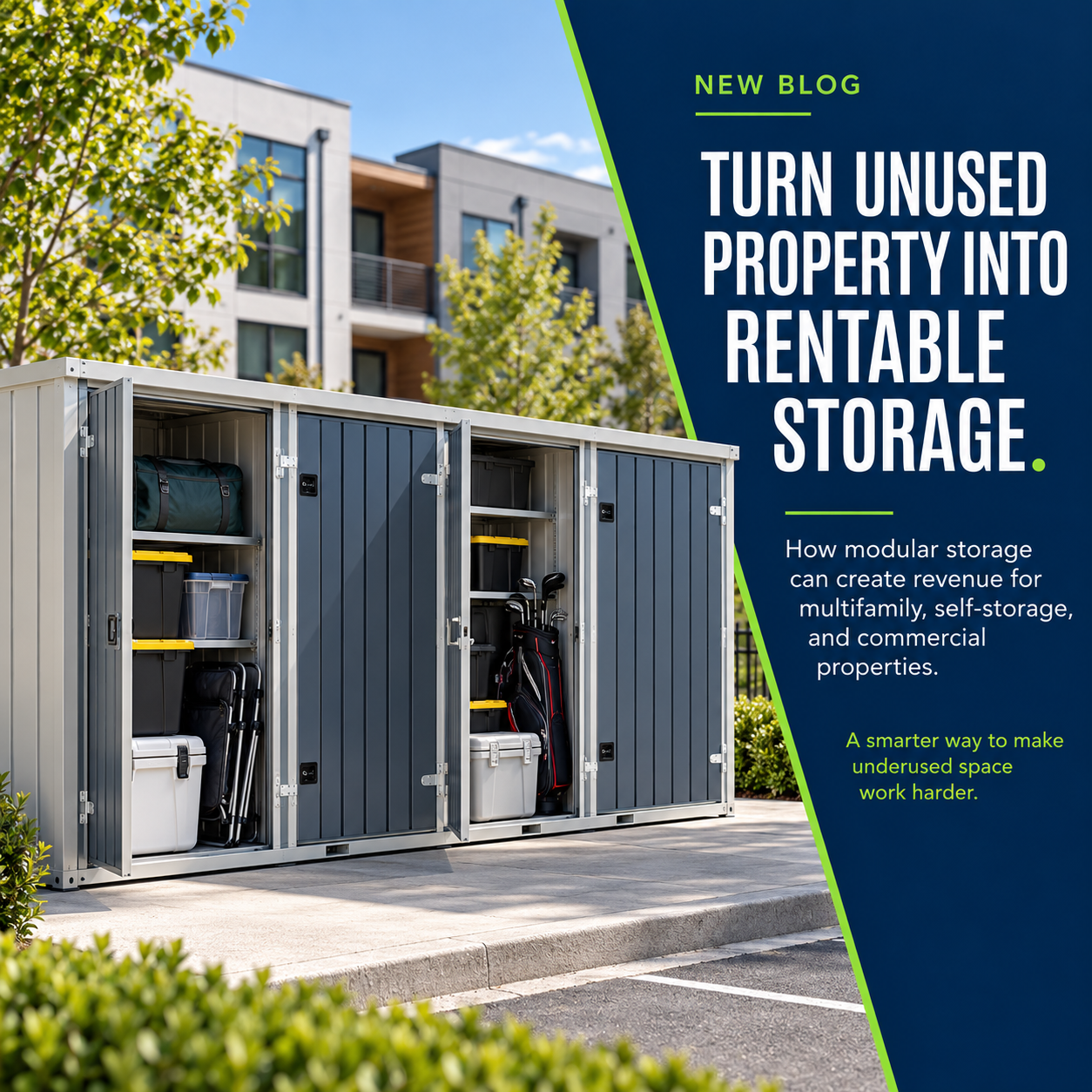
Modular Building Solutions offers individual storage units as well as multi-compartment configurations that can create separate secured spaces within one structure.
For self-storage operators, that can mean placing additional rentable inventory on parts of the property that are already owned. For multifamily operators, it can mean creating an amenity residents are willing to pay for. For commercial owners, storage can be assigned or leased to tenants that need more room without adding permanent interior square footage.
The financial model is refreshingly easy to understand:
Monthly rent × rentable compartments × occupancy = potential gross storage revenue.
For illustration, four storage compartments rented at $100 each would generate $400 per month, or $4,800 annually, before expenses. At $125 each, the same four spaces would generate $6,000 annually.
Those numbers are examples rather than guarantees—the appropriate rate depends entirely on the local market, unit size, demand, security, accessibility and competition. The important point is that previously non-producing space now has a way to generate measurable revenue.
This Is Particularly Interesting for Smaller Storage Units
Large storage spaces are not always the hardest inventory to find.
Customers frequently need somewhere for seasonal items, apartment overflow, business records, tools, sporting equipment, inventory or belongings that no longer fit comfortably inside a home or office. They may not need a garage-sized unit; they simply need secure additional space.
That creates an opportunity for properties where smaller footprints can be added strategically rather than building another long row of conventional units.
A multi-compartment modular structure can provide separately accessible storage spaces while concentrating multiple rental opportunities into a relatively small area of the property.
Flexibility Has Financial Value Too
Permanent construction is valuable partly because it is permanent.
That permanence can also be a limitation.
Markets change. Properties are sold. Parking requirements shift. A future building may need the space. Tenant demand can move from one part of a portfolio to another.
Modular storage preserves options.
Units from Modular Building Solutions can be disassembled and relocated when property needs change. A configuration that works at one site today can potentially be moved, repurposed or redeployed later instead of becoming a permanent constraint on the site plan.
That flexibility reduces one of the largest psychological barriers to improving an underused area: What if we need that space for something else later?
You can create productive space now without necessarily deciding what that corner of the property must be forever.
Multifamily Operators Have Another Opportunity: Amenity Revenue
Apartment communities have become increasingly sophisticated about ancillary revenue. Residents already pay additional fees for garages, reserved parking, pet services, package solutions and other conveniences.
Storage fits naturally into that model because apartment living frequently creates a space problem.
Bicycles, holiday decorations, outdoor equipment, luggage, children's items and hobbies can quickly consume valuable living space. A secure storage option located on the property solves a real resident problem while creating a potential recurring revenue stream for ownership.
It may also make better use of an awkward property area that has little value as parking, landscaping or recreational space.
That is not simply adding a metal box behind an apartment building. Done intentionally, it is adding another rentable amenity.
Business Parks Can Use the Same Model
Small commercial tenants often outgrow their storage before they outgrow their offices.
A contractor needs somewhere for tools. An ecommerce company needs inventory overflow. A service business needs supplies. A medical tenant has archived materials. A maintenance company needs equipment storage.
Moving into a larger suite simply to gain storage is expensive for both tenant and landlord.
Adding modular storage elsewhere on the property can create an alternative. The tenant stays in the space that works for the business, while the property gains another potential revenue source.
Again, the value is not simply the square footage. It is creating the right kind of square footage.
Run the Numbers on the Space You Already Have
Commercial real estate ROI discussions usually begin with acquisition, development or renovation. Sometimes the more interesting opportunity is sitting on property you already own.
Walk the site. Look at the unused pavement, awkward corners and excess yard space. Consider whether tenants, residents or customers are already asking for storage. Research what comparable small storage spaces rent for in your market, estimate realistic occupancy, and compare that revenue with the cost of adding modular units.
You may discover that the empty corner is not empty at all. It is an undeveloped revenue stream.
Modular Building Solutions can help you evaluate individual and multi-compartment storage options for self-storage properties, multifamily communities, business parks and commercial sites throughout the Southeast. Contact us to explore what could fit on your property.