
Why Construction Companies Are Taking a Different Look at Jobsite Space
Construction sites change constantly. Access points move, laydown areas shrink, crews shift from one section of the project to another and what worked during sitework may be completely wrong once the building starts going vertical. That creates an ongoing need for space on the jobsite. Secure storage is part of it, but so are offices, receiving areas, check-in points and small operational spaces that help the project run more efficiently.
Traditionally, contractors have relied on Conex containers, job trailers and temporary structures to cover those needs. They still make sense in plenty of situations. FlatBox simply gives construction companies another option—one designed around mobility, access and the reality that the next project may look completely different from the one you're working on today.
Start With Storage That Can Go Where the Work Is
A traditional shipping container is durable and familiar, but placing one on a crowded jobsite isn't always simple. The delivery truck needs enough room to enter, turn, position the container and get back out. Gates, fencing, neighboring buildings, equipment, overhead obstructions and changing site conditions can all limit where that container can realistically go. FlatBox storage units arrive flat-packed and are assembled where they're needed. That can make a significant difference on dense commercial sites, renovations, multifamily projects and other locations where access is limited. Instead of choosing the storage location based on where a large delivery truck can maneuver, the project team has more flexibility to place storage closer to the crews, materials or phase of work it is supporting. As the site changes, the unit can move too.
The Same System Can Cover More Than Storage
Storage is only one of the temporary space needs on an active construction site.
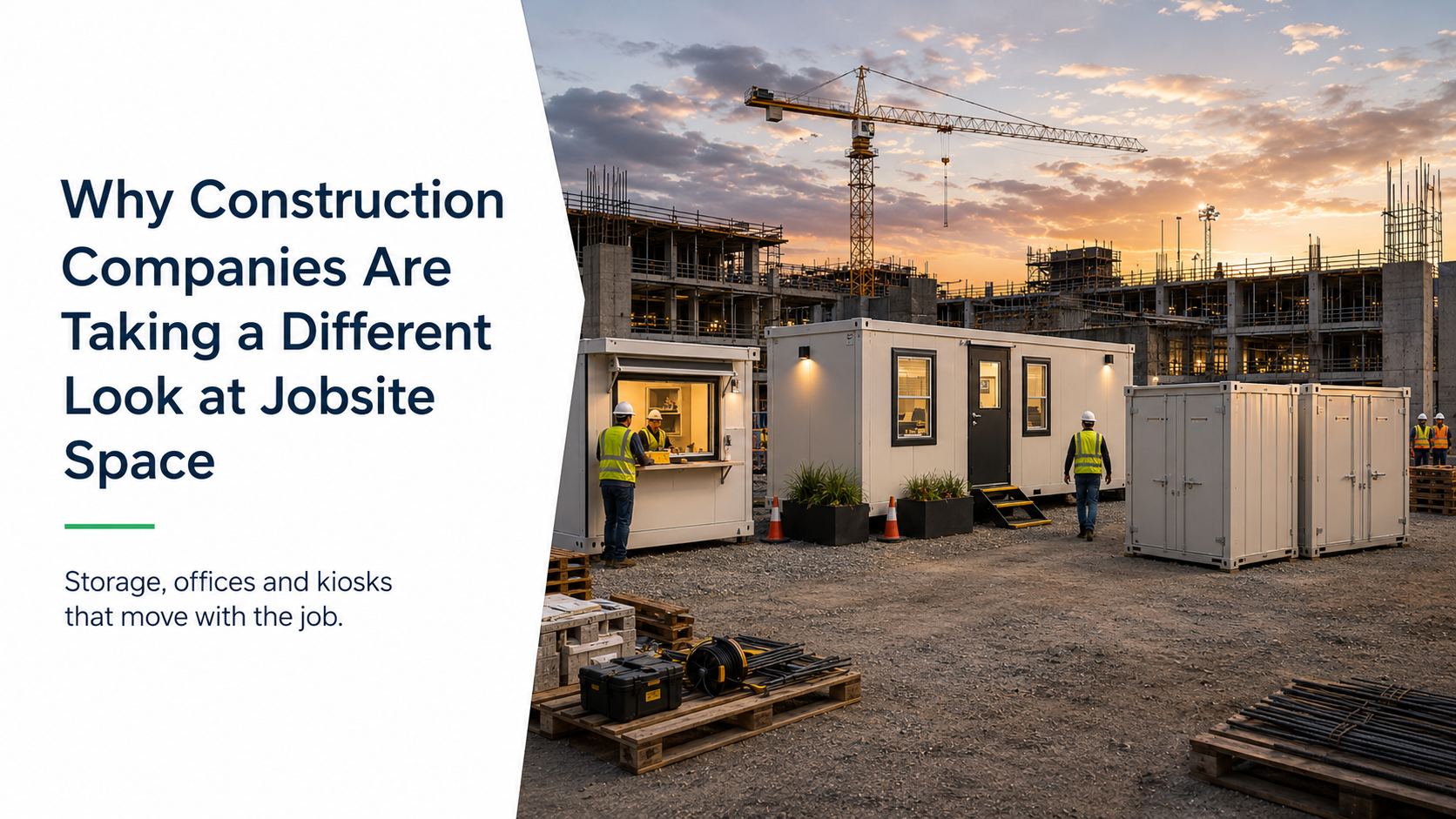
Project managers and superintendents need somewhere to work. Deliveries need somewhere to check in. Visitors and subcontractors need clear points of contact. Larger sites may need satellite offices or small operational stations closer to the work rather than sending everyone back to one central trailer. FlatBox office and kiosk units can fill those roles using the same compact, portable approach. An office unit can provide dedicated workspace for a superintendent, project manager or field team without requiring another traditional job trailer. It can be positioned closer to a specific phase of the project, used as a satellite office on a large site or relocated as the job progresses. Kiosk units can work well for receiving, security, visitor check-in or other small jobsite functions where you need an enclosed, professional space but do not need a full office. That allows a contractor to think about the jobsite as a system instead of solving every need with a different temporary structure.
Receiving Can Be Small and Still Be Important
Receiving is one of those jobsite functions that can create a surprising amount of friction when there is no clear place for it. Drivers arrive looking for someone to sign. Small deliveries get dropped wherever there is room. Visitors enter through the wrong gate. Subcontractors are trying to figure out where they need to report. A compact kiosk at the right entrance can create a dedicated point for receiving, security or check-in without taking up valuable jobsite space. On a larger project with multiple entrances, that small footprint can be especially useful. You get a defined operational space exactly where it is needed without committing a much larger trailer or container to a function that only requires a few feet.
Offices Should Be Able to Move With the Project Too
Traditional job trailers tend to stay in one place because moving them can become its own project. The construction site does not stay in one place. As a project develops, the best location for the field office may change. A superintendent may need to be closer to one part of the work during one phase and somewhere completely different several months later. Portable office units give the team more flexibility to position workspace around the project instead of forcing the project to operate around the office. For contractors running several projects at once, the same unit can also move to the next job when the current one wraps up. That turns temporary office space into something the company can own, standardize and reuse across multiple projects.
Your Storage and Office Space Can Become Part of Your Brand
There is another advantage that has very little to do with square footage. A well-run construction site looks organized. Fencing, signage, trailers, equipment and temporary structures all become part of how the project is perceived by owners, inspectors, subcontractors and anyone driving past the site. FlatBox storage, office and kiosk units can be branded to match the contractor using them. Instead of a collection of unrelated rental containers and trailers, the site can have a consistent, professional look. For companies doing high-profile commercial work, multifamily projects or highly visible developments, that can reinforce the same brand standards carried through trucks, signage, safety gear and project communications. Over time, it also gives the company a recognizable fleet that moves from project to project.
The Real Cost Is Bigger Than the Monthly Rental
Temporary jobsite space can look inexpensive when viewed one month at a time. Rent a container. Rent a trailer. Pay the delivery fee. Move it once the site changes. Pay another delivery or relocation fee. Start again on the next project. Across several active projects and several years, those recurring costs become significant. FlatBox changes that conversation because the units are purchased as reusable assets. Storage units, offices and kiosks can be redeployed from one project to another rather than restarting the rental process every time a job begins. The comparison is not simply the cost of one FlatBox versus one rented container. For an executive managing a portfolio of work, the more useful question is what the company will spend over the next five or ten projects on storage, office space, receiving stations, delivery, relocation and repeated rentals. Ownership, transportation efficiency and reuse can change that equation considerably.
One System Can Follow the Entire Project
The real value of FlatBox on a construction site is not any single product. It is the ability to create a jobsite setup that can change with the work. Storage units can keep tools, materials and equipment secure. Office units can give project managers and superintendents dedicated workspace. Kiosks can handle receiving, security, check-in and other small operational needs. As the site develops, those spaces can move. When the project ends, they can move again—to the next job. Construction companies already expect their people and equipment to travel from project to project. There is no reason temporary jobsite space cannot do the same. Traditional Conex containers and job trailers will continue to make sense in many applications. FlatBox simply gives contractors another way to build out a site—one that can be easier to deploy, easier to reposition and easier to reuse as the company moves from one project to the next.