
The Next Opportunity for Storage Container Rental Companies: Adding Modular Building Solutions to the Fleet
If you already rent storage containers, you do not need to be convinced there is demand for portable storage. Your customers are already calling for it.
Construction companies need secure space on active jobsites. Businesses need overflow inventory storage. Homeowners need temporary space during renovations and moves. Industrial customers need equipment and materials protected without adding permanent square footage.
The question for a storage rental company is no longer whether customers need containers. It is how many different storage problems your fleet can solve.
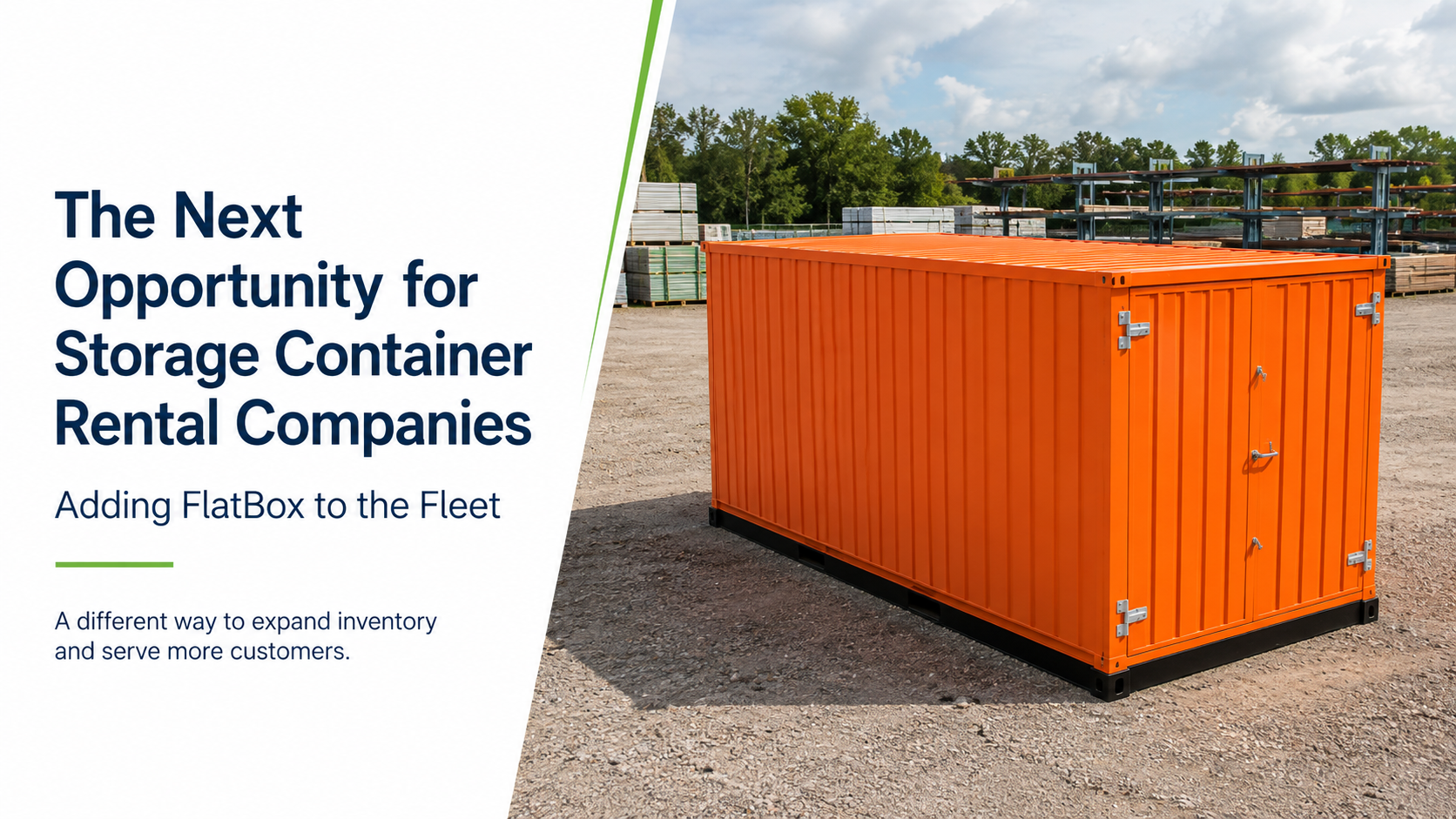
Traditional Conex and shipping containers will continue to be an important part of that fleet. They are familiar, durable and well suited to plenty of applications. FlatBox storage units add something different: a portable storage option that arrives flat-packed, can be assembled where it is needed and gives rental companies another way to serve customers when traditional container delivery, placement or size is not the best fit.
For companies already in the container rental business, that is where FlatBox gets interesting. It is not a replacement for what you already rent. It is another category you can put to work.
Your Existing Fleet Is Strong. FlatBox Fills the Gaps.
Look at the fleets of major rental companies and you will see a familiar pattern. Traditional storage inventory tends to center around standard shipping-container formats, with 20- and 40-foot units making up much of the market and some operators also offering 10-foot options. Those sizes work extremely well when the customer has the room and access to accommodate them, but they do not solve every storage problem.
A contractor may need secure storage inside a tight urban jobsite where maneuvering a fully assembled container into place is difficult. A business may need additional storage behind a building with limited truck access. A customer may have room for storage but not the clear approach required to place a traditional container exactly where they want it.
Those are not necessarily lost customers today. Sometimes the unit gets placed farther away, sometimes another solution is found, and sometimes the rental simply does not happen. FlatBox gives you another answer.
Because the units are delivered flat-packed and assembled on location, placement is less dependent on getting a full-size container and specialized delivery vehicle into the final position. For customers dealing with tight gates, restricted sites or awkward layouts, that can be a real differentiator. Instead of telling the customer where the container can go, you have more ability to work around where they actually need the storage.
You Can Add Inventory Without Moving as Much Empty Air
Storage rental companies know that the container is only part of the business. Moving the container is the other part. A fully assembled storage container occupies its entire footprint every time it is transported, whether it is full of a customer's belongings or completely empty.
Flat-pack technology changes that equation. Units travel in a compact format before assembly, allowing multiple units to be transported using significantly less space than the same number of fully assembled containers. For an operator adding inventory, opening another market or moving new units between yards, that can make the logistics of fleet expansion much easier to manage.
It can also change how you think about storing unused inventory. Traditional containers require their full footprint whether they are producing rental income or waiting for the next customer. Flat-packed units can take up considerably less yard space before deployment.
For an established rental company, yard space and transportation are not minor details. They are operating costs, and a product that uses both differently deserves a closer look.
A New Product Gives Your Sales Team Another Reason to Call Existing Customers
The best part about adding FlatBox to an established rental operation is that you do not have to build a new customer base. You already know the customer.
The general contractor renting a 20-foot Conex may also have a project where access is tighter. The property manager may need additional storage in a location that cannot easily accommodate a traditional delivery. The manufacturer may need a smaller secure unit close to one department instead of another large container at the edge of the property. The customer calling for temporary office space may also need a compact receiving or security kiosk.
Those conversations are already happening. FlatBox simply gives your sales team more ways to answer them.
That matters in a competitive rental market. If several companies in the same territory can deliver essentially the same traditional storage container, differentiation becomes heavily dependent on price, availability and service. Offering something customers cannot easily get from the company down the road changes the conversation.
Now the sales rep can say, “We have another option.” That is a much stronger place to compete from than shaving a few dollars off the monthly rental rate.
FlatBox Can Expand More Than the Storage Side of the Fleet
The opportunity is not limited to storage units. Companies serving construction, industrial and commercial customers already see demand for temporary workspace and small operational spaces alongside storage.
FlatBox office units can support project managers, superintendents and field teams, while kiosk units can be used for receiving, security, check-in and other compact jobsite functions. That gives a rental operator the ability to build a broader FlatBox offering around the same customers already renting storage.
A contractor could rent storage units for tools and equipment, an office unit for the field team and a kiosk near the jobsite entrance for receiving or security. The rental company is no longer supplying one piece of the temporary site setup. It is solving several needs within the same account.
That is where a new product category can begin increasing revenue per customer rather than simply competing with something already in the fleet.
You Do Not Have to Change the Business Model
There is another reason FlatBox makes sense for established rental operators: the business model is already familiar. You purchase a durable asset, deploy it to a customer, collect rental revenue and put the asset back to work again when the rental ends.
FlatBox fits naturally into that model. The difference is in how the product is transported, placed and redeployed. The customer gets secure usable space, while the rental company gets another asset capable of generating revenue across multiple rental cycles.
For operators accustomed to evaluating fleet purchases based on utilization, transportation, maintenance and revenue potential, FlatBox should be evaluated the same way: not as a novelty, but as fleet equipment.
Fleet Growth Does Not Have to Happen All at Once
Rental companies also understand the danger of buying too much of the wrong equipment. Customer demand determines a successful fleet, not the size of the order.
FlatBox gives operators an opportunity to introduce a new category incrementally. Add several units, put them into the market and learn which customers respond, which applications generate the strongest demand and how the units perform within your operation. From there, expansion can be based on what the market is actually telling you.
That approach is especially useful when introducing a product customers may not know to request yet. You do not need every customer to recognize the term “flat-pack storage.” Your sales team simply needs to recognize the situations where it solves the problem better.
Limited access, changing jobsites, compact placement, multiple units going to one customer and a need for storage, office and kiosk space on the same site are all situations where FlatBox can create a stronger answer.
The Competitive Advantage Is Having Another Answer
The storage rental market is not short on shipping containers, and that is exactly why adding a different type of solution can matter.
Your traditional fleet will continue serving the customers it serves well. FlatBox gives you another tool for the customers and locations where traditional delivery or placement creates friction, while also opening the door to office units, kiosks and other temporary-space rentals.
For companies like United Rentals, Herc Rentals and regional storage-container operators, the opportunity is not to abandon the equipment customers already know. It is to broaden what the fleet can do.
When a customer calls with an unusual site, a difficult entrance or a need that does not fit neatly into a traditional container setup, the rental company with another option has an advantage. That is the opportunity FlatBox brings to the rental market: another rentable asset, another problem your team can solve and another reason for customers to call you first.